

Expert Neurology Care, Made Simple

Supporting you and your loved ones—from the comfort of home

Cutting-Edge Treatment

Welcome to the Synapticure community and thank you for taking the first steps to getting expert care for Dementia. We're truly honored to have you with us.

By registering, you’re not only exploring potential care options for yourself or a loved one — including access to cutting-edge treatments like Amyloid Therapies — you’re also contributing to research that could make a real difference for others facing similar challenges. We’re deeply grateful for your willingness to be part of this important work.

The Synapticure Way

When you begin your journey with us, you can expect to:

Schedule Intake

Schedule Intake

Book a no-cost virtual intake with us. We’ll answer questions, offer guidance and help with care navigation.

Meet Your Dedicated Care Team

Meet Your Dedicated Care Team

You’ll meet our dedicated team of professionals, here to support you every step of the way. Our team are experts in amyloid therapies, and Alzheimer’s clinical trials.

Get a Care Plan

Get a Care Plan

A personalized care plan is built around your daily needs at home.

Receive 24/7 Support

Receive 24/7 Support

Receive day and night access to care coordination services.*If you opt-in*

Our Experts

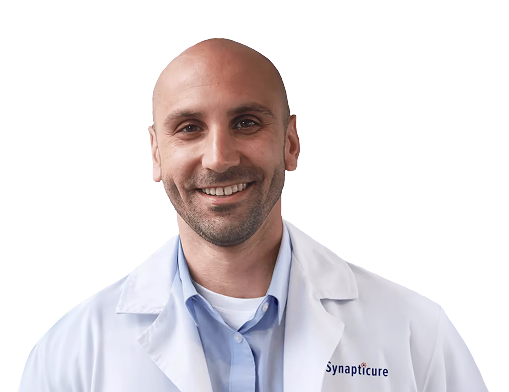
Oleg Yerstein

Director of Cognitive Care Service Line, Neurologist

Former Director of the Center for Memory and Cognitive Disorders at Beth Israel Lahey Health, Dr. Yerstein brings extensive expertise in dementia biomarkers, anti-amyloid therapies, and Alzheimer’s clinical trials.

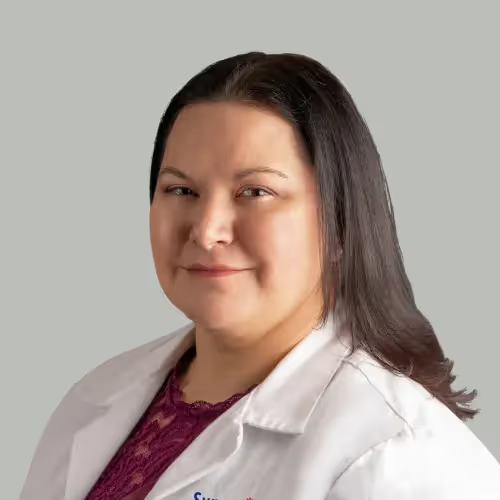
Noreen Flanagan

Director of Behavioral Health, Psychiatrist

Dr. Flanagan has dedicated over 20 years to neurodegenerative care, pioneering interdisciplinary programs in Memory Clinic and tele-psychiatry to ensure comprehensive care for all, now continuing her passion at Synapticure.

Jeremy Pruzin

Cognitive Neurologist

Dr. Jeremy Pruzin is a behavioral neurologist researching and treating Alzheimer’s and related dementias, with a focus on prevention through lifestyle and risk factor management.

In-network coverage for all 50 states

Please note that we may be considered out-of-network with your insurance provider. Coverage and reimbursement may vary depending on your specific plan. We recommend contacting your insurance company directly to confirm your out-of-network benefits before your visit. If you have any questions or need assistance with this process, our team is happy to help.

Hear why Patients and Caregivers love Synapticure

Frequently Asked
Questions

Visit our full FAQ page for more commonly asked questions.

Amyloid therapies, which currently include lecanemab and donanemab, are a new class of medications that work by clearing amyloid from the brain. Amyloid is a key protein that accumulates into abnormal plaques involved in Alzheimer’s disease.

We’ll need the following records to help you make a decision on treatment:

Step 1: Confirm the Diagnosis. These therapies are only for people in the early stages of Alzheimer’s disease (mild cognitive impairment or mild dementia). They are not a cure, they slow the progression of symptoms by about 30-40%.

Your care team, led by a memory specialist, will review your history, any prior testing completed elsewhere, and current symptoms, perform cognitive testing, and may recommend blood work, a brain MRI or additional testing to make a diagnosis.

Step 2: Confirm pathologic accumulation of Amyloid in the Brain. Proof of amyloid buildup is required before treatment. This can be shown through:

  • An amyloid PET scan, or
  • A blood test (in some cases, to help guide next steps, though expect to need a spinal fluid or PET test in most cases to confirm eligibility). or
  • For patients who have had it done already, spinal fluid (lumbar puncture) test results may be sufficient to determine if there are amyloid plaques in the brain. 

Step 3: Complete a Safety Screen.  We’ll need:

  • MRI: A brain MRI to understand eligibility for treatment and if eligible, to make sure the risk of amyloid-related imaging abnormalities (ARIA), a potential side effect of small bleeds or temporary swelling, is known and acceptable to you and your care team. We can help you get this test done, or use an existing recent MRI if you have one.
  • Genetic testing: A genetic test for the APOE gene – different APOE genes affect risk for ARIA. We can do this from your home or in a local lab.

Your medical history, medications (especially blood thinners), and blood pressure will also be reviewed, some medications cannot be taken with these treatments. We’ll work with your current medical team to collect this on your behalf.

  • Risk for ARIA largely depends on a person's APOE genes and findings on the brain MRI prior to starting treatment - it can range from less than 5% to about a 30% chance of occurring.
  • ARIA generally does not cause symptoms, if it does occur, it is usually found on MRIs done to monitor treatment, symptomatic ARIA generally occurs in less than 2% of persons treated.
  • The most common symptom of ARIA is headache, other symptoms include balance problems, dizziness, visual changes, and temporary worsening of confusion. 
  • Swelling related to ARIA resolves on its own with time.
  • ARIA, especially the small bleeds, also occur in the absence of treatment, but are more common with treatment.
  • If swelling related to ARIA occurs, treatment can usually be resumed after the swelling has resolved on its own. There are however some instances when treatment must be discontinued.

Once your care team has confirmed the diagnosis, the presence of abnormal amyloid levels, and finished the safety screens including a discussion of risks and benefits of treatment,your case may then need to be presented to our panel of clinical and patient safety experts to approve treatment. Our care team will then work with you and your insurance company to find and book you into an infusion center to support ongoing care.

These medications are currently given by IV infusion, either every 2 or every 4 weeks, in an infusion center or clinic.
Follow-up MRIs are required during the first year to monitor the brain for potential side effects of swelling or small bleeds, which are the two forms of ARIA.
Your care team will also monitor your memory, daily function, and any new symptoms.
Initial treatment continues until amyloid plaque is cleared from the brain, which usually takes 6-18 months.

Treatment decisions are individualized — your neurologist and care team will discuss the potential benefits, risks, and what to expect over time.

Even while on therapy, it’s important to continue healthy lifestyle habits, control other medical conditions like high blood pressure, and attend regular follow-up visits.

Options for ongoing treatment after the initial 6–18-month period during which amyloid plaque is cleared should be discussed with your doctor.

Patients and Caregivers 
Love Synapticure

We love the kindness and care from Rebecca and Dr. Jaimie Hatcher-Martin.Great service offered to ALS patients as well as Compassionate, help and understanding!!!

Caregiver, ALS

Great people all around. Taking great care of pALS and cALS. Predictable access and patient-centered support using a solid telehealth network.

Caregiver, ALS

Synapticure and support with speech therapy has been a true blessing in helping to care for my wife with Alzheimer's disease. Today Kylee was able to bring out her thoughts as she changes.

Caregiver, Alzheimer's

What could have been traumatic was actually very pleasant. Raven brought out the best in him—he was totally at ease and actually proud of himself after the session. You wiped away any fear or doubt and proved that Synapticure is the real deal.

Caregiver, Frontotemporal Dementia

Our PCP was so impressed with the thoroughness of the notes from Synapticure. He was very excited about the new treatment options you recommended, which were new to him. For the first time, I don't feel like we're fighting the system alone.

Caregiver, Lewy Body Dementia

The willingness of my neurologist to prescribe off label has given me new hope in my fight with ALS. It allows me to try something new while waiting for a clinical trial. For anyone fighting ALS , time is of the essence and the speed that Synapticure is something other providers should strive for. Thank you for giving me hope!

Patient, ALS

Thank you for the access to genetic testing! It was discovered that I had a mutation of the SOD1 gene which has completely changed my treatment.

Patient, ALS

Thank you so much for creating this wonderful healthcare system. You are life savers in a world where we need all the help we can get. The care I've received from this dedicated team of professionals goes beyond any other healthcare available nationwide. Life with Parkinson's sucks but Synapticure helps guide their patients on how to live their best lives with chronic illnesses.

Patient, Parkinson's

Synapticure has been an order of magnitude improvement in my care and scope of care (neurology plus behavioral health). Discussions are always open (both directions) and thorough. In between scheduled appointments, my care team is very responsive to questions and needs.

Patient, Parkinson's

The support my wife and I have received from Synapticure since my PLS diagnosis in 2024 has been nothing short of exceptional. The fact that their high-quality, compassionate care is delivered entirely via telehealth has made access incredibly convenient for us. Their knowledgeable team provides much-needed clarity and peace of mind from the comfort of home. Truly a five-star organization.

Patient, Primary Lateral Sclerosis (PLS)

Everyone from synapticure has been VERY helpful; from Eva and Dr. Jamie Hatcher. They are so kind and make you feel comfortable. They never rush you and they get things done so quickly.

Synapticure Patient

Comprehensive Neurology Care 
All in One Place

Schedule a consultation call with a Synapticure care coordinator to discuss 
your needs and learn how we can help.

illustration of connected nodes